


Metal-free implant solution for a biocompatible restoration
Ceramic implants provide a permanent replacement for missing teeth and permanently take over the function of the natural tooth root.
For Medic Dentist Alina Ionita, it is not only stability and aesthetics that are important, but above all a restoration that is as biocompatible as possible and metal-free.
That is why, whenever medically appropriate, she relies on ceramic implants as part of her
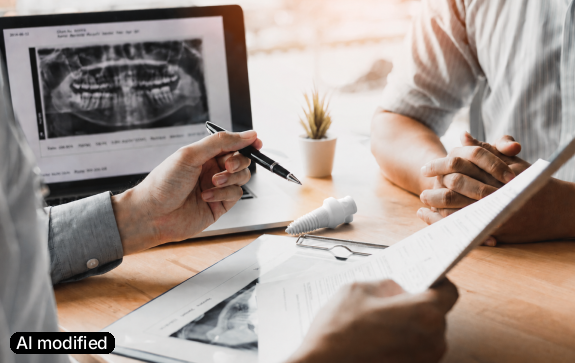
Every implant procedure at our practice begins with a thorough diagnostic evaluation and a personalized treatment plan. Using a 3D X-ray, Medic Dentist Alina Ionita assesses, among other things, the bone condition, the position of the implant, and the long-term conditions necessary for a stable restoration.
Implant placement may still be possible even with limited bone volume. If necessary, minimally invasive bone augmentation procedures are available to create favorable conditions for a long-term, stable implant restoration.
In four steps to your metall free implant
Every implant procedure begins with a detailed analysis of your initial condition. This analysis takes into account bone structure, dental condition, and functional requirements. The treatment plan is customized based on a detailed 3D X-ray image.

Diagnostics & plannings
A thorough assessment of your initial condition and three-dimensional planning of the implant position

Implantation
Placement of the ceramic implant in the jaw

Healing phase
Controlled healing and integration of the implant with the surrounding tissue

Supply
Controlled healing and integration of the implant with the surrounding tissue

What Sets Ceramic Implants Apart
Ceramic implants have certain material-specific properties that must be taken into account during treatment. These include, among others:
No electrical conductivity: Ceramic is not electrically conductive. This material property is considered in biological dentistry when selecting an implant restoration.
- No oxidative reaction of the material: Ceramic is considered chemically stable and does not react like a metallic material. This aspect plays an important role for Dr. Alina Ionita in her biologically oriented selection of materials.
High tissue compatibility: Ceramic implants are often considered well-tolerated because they integrate smoothly into the surrounding tissue and do not cause additional irritation.
Aesthetically unobtrusive integration: Thanks to their light color, ceramic implants can be integrated into the restoration in an aesthetically unobtrusive manner. This can be particularly advantageous in the visible dental area.
Special Features of Implant Treatment in Willingen
Medic Dentist Alina Ionita plans each implant treatment individually based on the patient’s bone and tissue conditions. In suitable cases, a ceramic implant can be placed immediately after tooth extraction.
Such immediate implantation can help reduce the number of treatment steps and, under certain conditions, avoid the need for an additional surgical procedure. Whether this approach is possible and medically appropriate is carefully evaluated in advance.
Preserving and targeted building of bone
After losing a tooth, the jawbone in that area can recede over time. However, a sufficient bone base is essential for a stable implant restoration.
Medic Dentist Alina Ionita therefore assesses early on whether measures to preserve or rebuild the bone are necessary. Depending on the initial situation, these measures can be taken immediately after tooth extraction or in preparation for implantation.
In addition, the A-PRF technique can be used. In this procedure, the body’s own components are prepared from a small amount of the patient’s own blood to support natural wound healing and tissue regeneration.
The goal is to create the best possible conditions for a long-term, stable restoration with a ceramic implant.
FAQ
Answers of your Medic Dentist Alina Ionita
Why is ceramic often the material of choice in biological dentistry?
Why does dentist Alina Ionita rely on ceramic implants?
What exactly are ceramic implants?
How do ceramic implants differ from traditional implants?
Are ceramic implants just as stable as other implants?
Is immediate implantation possible?
How long does a ceramic implant last?
How long does the healing process take after an implant procedure?
Is bone grafting always necessary after a tooth extraction?
Why is having enough jawbone so important for an implant?
What is immediate implantation?
NEW & WORTH KNOWING